

True Intimacy
“If you think you’re enlightened, go spend a week with your family.”

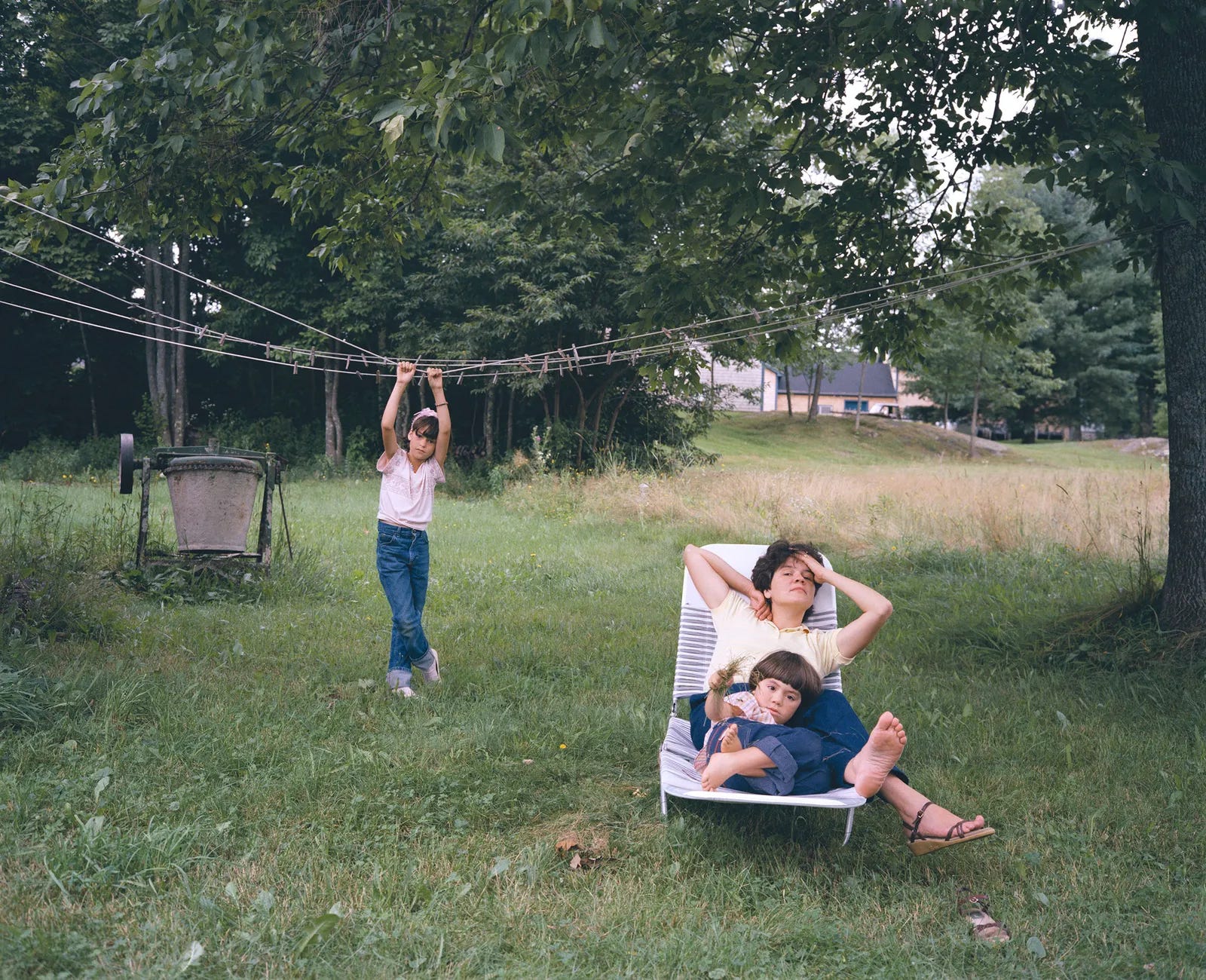
-Lincolnville, Maine, 2000 by Jo Ann Walters
“If you think you’re enlightened, go spend a week with your family.” - Ram Dass
This is perhaps the quote I refer to most during this season. I’ve been reflecting time and time again on how the deeper intimacy goes, the “harder” it can be to navigate. Like fine grains of sand settling ever deeper, closeness brings more texture—yes, more friction, but then, too, more opportunities for growth. New relationship energy is easy. And I mean that across all forms of relationships. There is novelty, curiosity, and just enough blank space to hold all of our positive projections.
This is the mythic dance of Eros and Psyche at one of its strongest expressions. A beloved Pacifica professor, Mike Elliott, used to say, “Eros wants to want.” Mystery feeds desire. But as more is illuminated while coming into knowledge of others, there is less room for fantasy and a stronger pull toward what is real, unresolved, and alive. And when we shy away from that, we ultimately shy away from ourselves.
What feels like the true mark of relational maturity is not ease but the capacity to work with moments of friction and still find a way toward deeper connection that doesn’t extinguish the curiosity and vitality that Eros brings.
You don’t need to be a therapist to know that relationships are difficult. We yearn for connection and yet spend so much of our lives sowing the seeds of our own separation. This is not to say that we are all out here engaging in self-sabotage. But who among us has not gotten in their own way or undermined themselves or their relationships at one point or another?
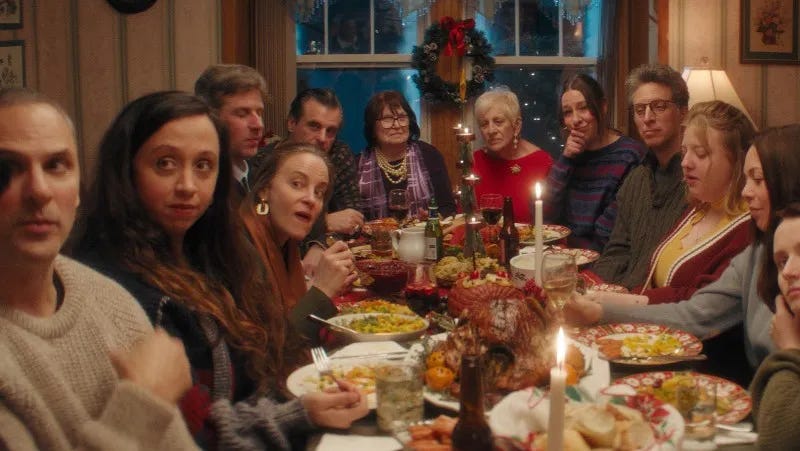
-Still from Christmas Eve at Miller’s Point, 2024
One of the main failings of contemporary therapeutic work is the inherent selfishness of the process. We spend an inordinate amount of time in individual therapy processing relational experiences and their effect on us, which can contribute to this sense of separation. Sessions often focus on how various relationships strain us, prod our wounds, and challenge us to stretch in uncomfortable ways. There’s a kind of narcissism at work here, living in a near constant state of self-reflection. And, yes, some of us may need that time to rebalance and be self-focused as a way to return to oneself. Because, while some people are so trapped inside their own experience that they do not think of others, in the inverse, some can be so focused on other people that they fail to think of themselves.
But there comes a time, regardless of where you fall on that spectrum, when we (hopefully) have the opportunity to mature to the point of being able to hold that interdependent “we” that is so essential to living in relation to others. We cannot do this if we’re only thinking of ourselves, nor exclusively others. The work, as we’ve said before, is meant to leave the room. We aren’t meant to self-assess and analyze endlessly, but practice relating in order to improve our relationships out in the world. Real emotional, relational maturity is leveling up to the realization that we are not “we” without me + you. Reaching “we” requires both sets of awareness to blend. But that cannot be done if we aren’t taking the insights and lessons learned in our therapy sessions and attempting to integrate them—especially when it can feel uncomfortable to do so.
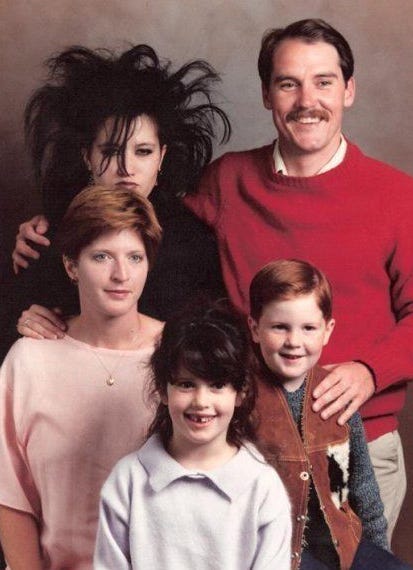
- “Awkward Family Photos” throwback.
Then there is family (cue the ominous music). Even in families with solid communication, there are blind spots, old dances of avoidance and control, pursuit and withdrawal. And often part of why family is so hard is simply because we often project our idea of who they are in a way that freezes them in time. And, of course, they may do the same to us. Projection is a natural process that is happening all of the time whether we are aware of it or not. So while we constantly become new versions of ourselves each and every day, we return home where everyone, including ourselves, assumes the regressive roles and returns back to the norms and traditions of the past.
Of course this looks different from person to person and family to family––avoidance, defensiveness, and resistance can cause a kind of freeze in time, but that’s where pain can enter as a motivator. We’re more likely to change when we’re feeling uncomfortable. The greater the discomfort, the more motivation to bring it to an end. I go back and forth between whether or not I believe pain is completely necessary for individuation or growth, but it certainly gets the job done.
As a torn paper might seal up its side,
Or a streak of water stitch itself to silk
And disappear, my wound has been my healing,
And I made more beautiful by losses.
See the flat water in the distance nodding
Approval, the light that fell in love with statues,
Seeing me alive, turn its motion toward me.
Shorn, I rejoice in what was taken from me.
What can the moonlight do with my new shape
But trace and retrace its miracle of order?
I stand, waiting for the strange reaction
Of insects who knew me in my larger self,
Unkempt, in a naturalness I did not love.
Even the dog’s voice rings with a new echo,
And all the little leaves I shed are singing,
Singing to the moon of shapely newness.
Somewhere what I lost I hope is springing
To life again. The roofs, astonished by me,
Are taking new bearings in the night, the owl
Is crying for a further wisdom, the lilac
Putting forth its strongest scent to find me.
Butterflies, like sails in grooves, are winging
Out of the water to wash me, wash me.
Now, I am stirring like a seed in China.
-Howard Moss, The Pruned Tree
Relationships will never not pick at our old scabs. It can sometimes seem like we are constantly coming into contact with evolved forms of past troubles, made manifest in new people. But still, familial relationships can feel like the hardest test of all. An easy way out, and one so many of us seem prone to take, is to merely avoid the conflict innate in relationships. We keep people at arms length, or hold onto quiet resentments; we project onto others what we unconsciously judge about ourselves, or act passive aggressively.
Another strategy we’ve noticed growing is the weaponization of what is learned in therapy. The initial goal of therapeutic work ought to be repairing the ruptures that naturally occur between people (when appropriate, of course), versus configuring our lives in a way that detours around our relations in order to avoid uncomfortable conflicts. Similarly, the tools aren’t meant to dismantle most relationships, but strengthen them.
When therapeutic jargon leaves the room and joins with the great pantheon of pop-psychology, it can be almost guaranteed that the escaped term or phrase has been overly simplified or exaggerated to the extent that it might appear almost unrecognizable to an experienced therapist. Take, for example, the concept of boundaries. Boundaries are often confused as walls or heavily guarded borderlines, which must be fiercely defended. But this is a dangerous misconception. Boundaries aren’t walls meant to keep people out. They are conditions for engagement; terms to be met in order that we work together to solve the conflict between us. Sure, there’s no point coming to the table if these terms aren’t met, but beware constructing boundaries that are unrealistic to achieving a successful relational repair.
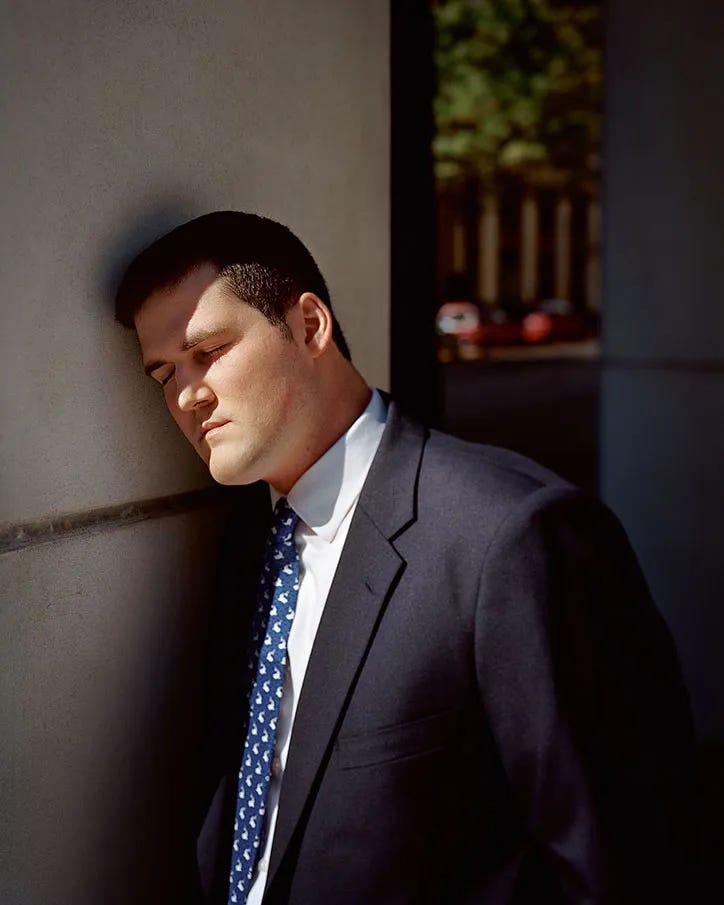
- Image by Shane Rocheleau
According to a recent article in the New Yorker, there is a surge in the number of people going “no contact” with their families. 27% of Americans, already, are currently estranged from a relative. This is not a judgment. For some people, these are necessary means. Perhaps those relationships aren’t important enough for them to fix, or maybe they are just too dangerous or unproductive to continue working on. But if we are in conflict with a loved one–someone whom we want in our life, but who is either the source of our primary wounding, or the latest to poke and prick our sensitive issues–then we are going to need to be willing (at some point) to have the conflict out in the open with honest and direct conversation, and then be willing to dig into the dirty work of repair that comes after.
Within the Jungian lens there is an insistence that relationships are never just about the other. Each person becomes a mirror and so relational work becomes self work, as well. This means the work is mutual, whether we agree to it or not. I am not me, you are not you, none of us are anyone without the other. Just as day is not day without darkness, intimacy, at its deepest, is where contradiction and conflict teaches us who we are.

- La Joie de Vivre, Paul Delvaux, 1937
Grass high under apple trees.
The bark of the trees rough and sexual,
the grass growing heavy and uneven.
We cannot bear disaster, like
the rocks—
swaying nakedly
in open fields.
One slight bruise and we die!
I know no one on this train.
A man comes walking down the aisle.
I want to tell him
that I forgive him, that I want him
to forgive me.
-Robert Bly, Passing An Orchard By Train
The beauty of psychotherapy, then, is that we get active practice at being in relationship with ourselves by relating to someone else. We can risk new ways of being, work through our more challenging or difficult feelings, and come into a deeper understanding of our patterns (conscious or unconscious), and take measures to make stronger choices out “in the real world.” Too frightened or intimidated by the notion of entering into conflict with family or friends? Practice it in the room. When your therapist grazes that old wound, work through it with them. This is what the process is meant to do. It isn’t designed for navel-gazing, but working the muscles required to maintain the most important aspect of human life: relationships.
Happy Holidays,
Inner Vision