

Ritual Time
How the Loss of Ritual & Heritage Impacts the Way We Experience Time

Is time getting faster? It seems like just the other day we were celebrating Valentine’s, and only a week before it was New Years. We’re already a fourth of the way through the year! The quickening of life is often chalked up as a side effect of getting older; every year a little faster, every day a laundry list of work to do that leaves us bereft of the precious currency. And though it may be true that speed is a symptom of age, there is a specific head-spinning quality to the rate at which time is flying nowadays, as if there were no roots to stop the soil from sliding away…
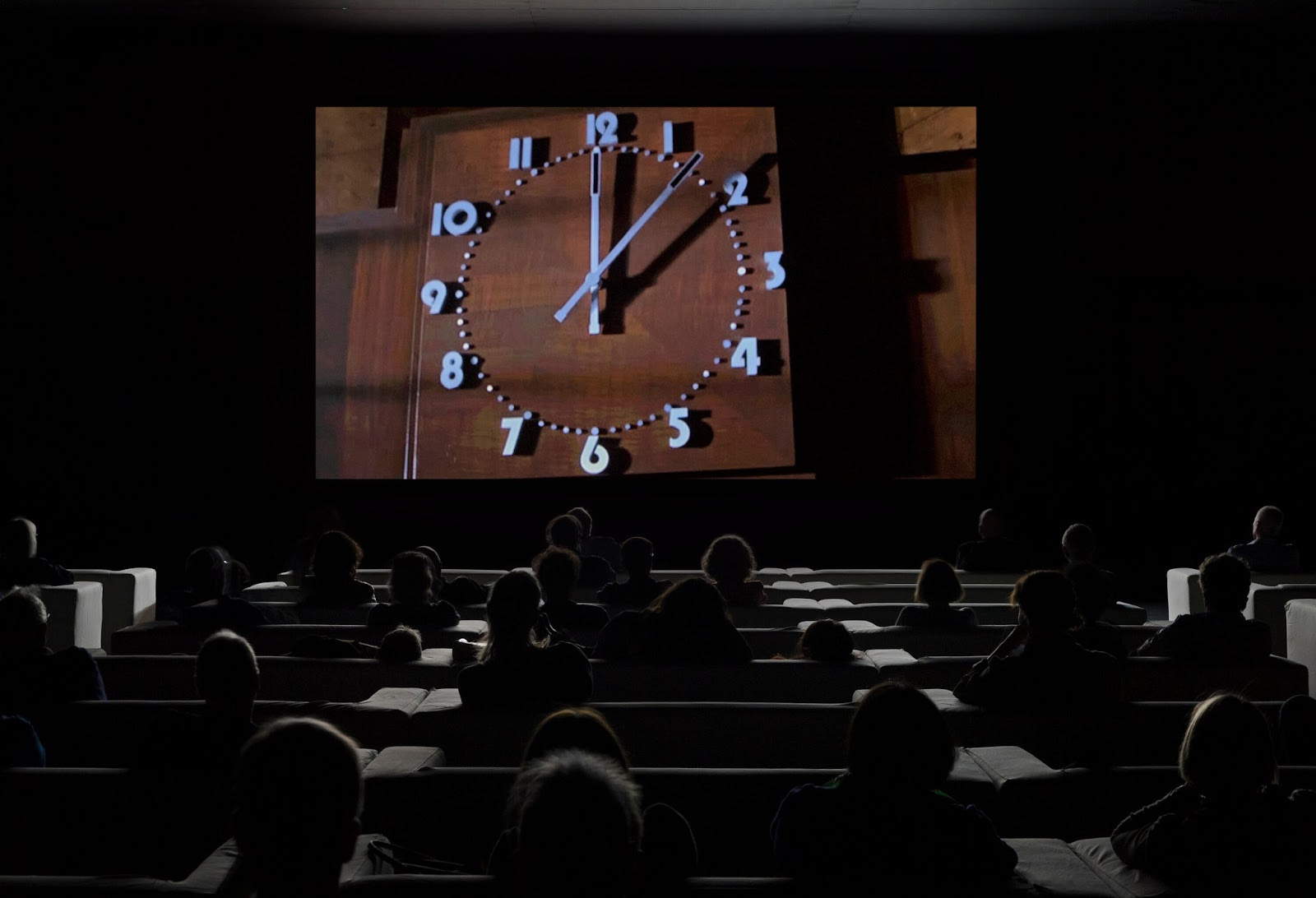
-Christian Marclay, The Collective Rhythm of Time
Listen while you read. Find the “Ritual Time” playlist here.
If you share our feelings you’re not alone. Philosopher Byung Chul-Han agrees. Han coined the term “Dyschronicity,” to describe this very sensation of being constantly rushed and unfulfilled, describing it as “the atomization of time.”
To atomize something is to break it into distinct parts, or to silo something or someone and deny them meaningful ties to others. In the way that a spray bottle turns a watery solution into a mist––to atomize is to create singular entities from a larger whole, fracturing their previous unification. But what does it mean to atomize “time?”
Storyteller Michael Meade once said about the phrase, “once upon a time,” that: ”nobody knows what that means, ‘Upon a time.’ But it has something to do with once, before time was digital, before time was caught and strapped onto people’s wrists, before time was captured and put on the steeple of all the churches up in the highest point of all the villages so that time dominated all the things going on below. Before time was singular, when there was a masculine time and a feminine time and a pregnant woman’s time and an old man’s time and a time for a little boy to walk around looking at the ocean. When time was a thing that you felt inside yourself and didn’t have to keep checking the radio for. Once, in that time…” and like that, his story began.
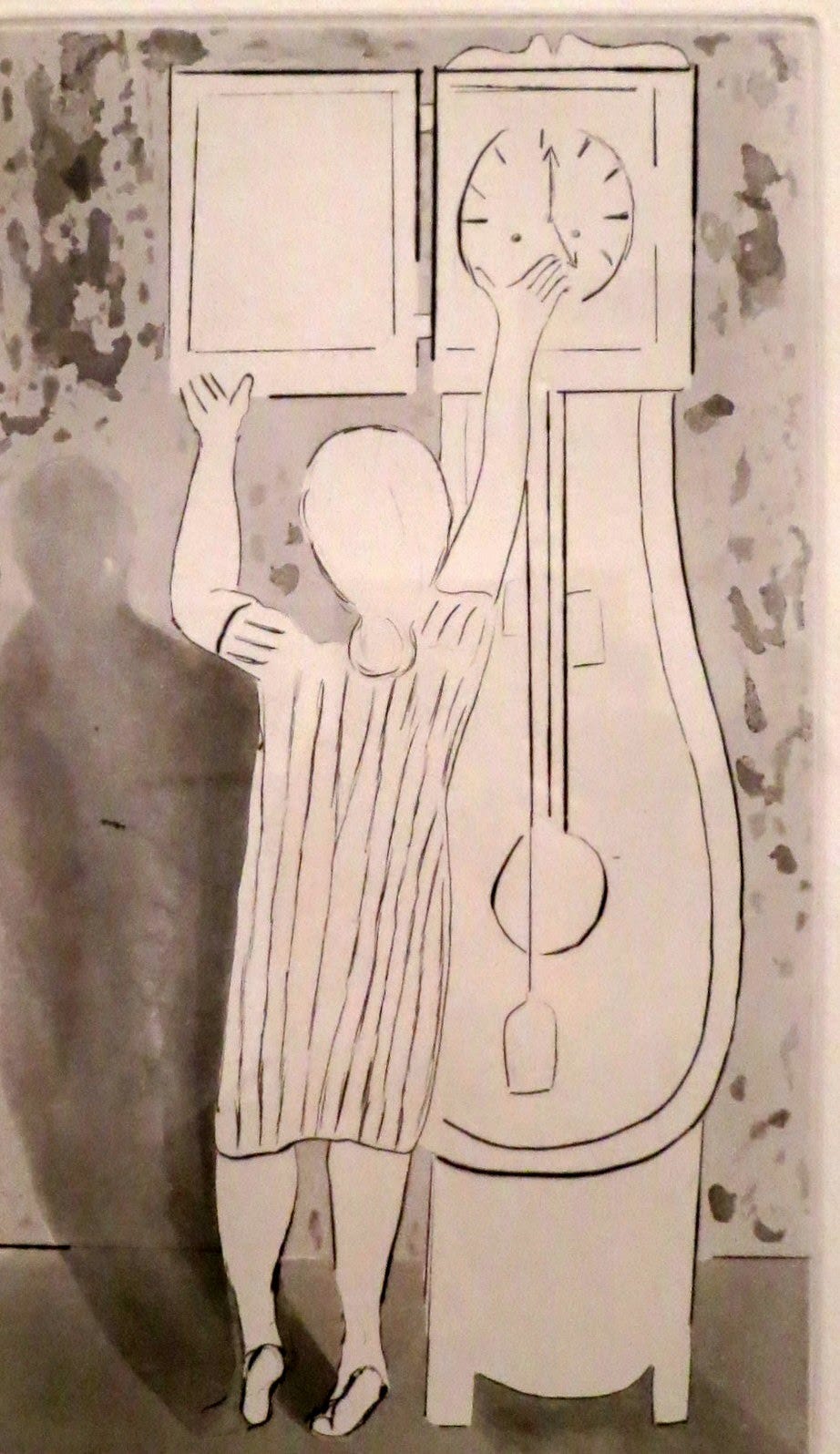
- Louise Bourgeois, Time Through a Feminist Lens
One might mistake the different kinds of fluid time described by Meade for atomization, but what Meade is talking about is a state of flowing duration, which is in stark contrast to the kind of time depicted by Han, made of unconnected moments or fragmented points. It’s true that time was perhaps first atomized with the invention of clocks, which subdivided time into hours, minutes, and seconds. But it is further dissolved today by the lack of time-based observances such as rituals or holidays that help steady the rate of time’s passing.
Han blames this dyschronicity on our modern drive for what he calls “vita activa” or “active life,” which has brought upon us an imperative to work, and to even become one’s work. We sometimes see ourselves as projects to be perfected and completed. Ever busy, ever fretting, hustling, exploiting ourselves in order to achieve. Achievement, according to Han, is the ultimate motivator as the Achiever becomes ones own boss, constantly pressing to maximize production. The cost of this active life of achievement is time for contemplation and creativity that leads, ultimately, to what Han calls “poverty of world.” We feel we can’t lay down without watching a show, or do the dishes without listening to a podcast. We mustn’t be bored or boring. Boredom is anathema to this sort of living. Something to be avoided at all costs. The feeling is that we must always be consuming or we are wasting our vita activa.
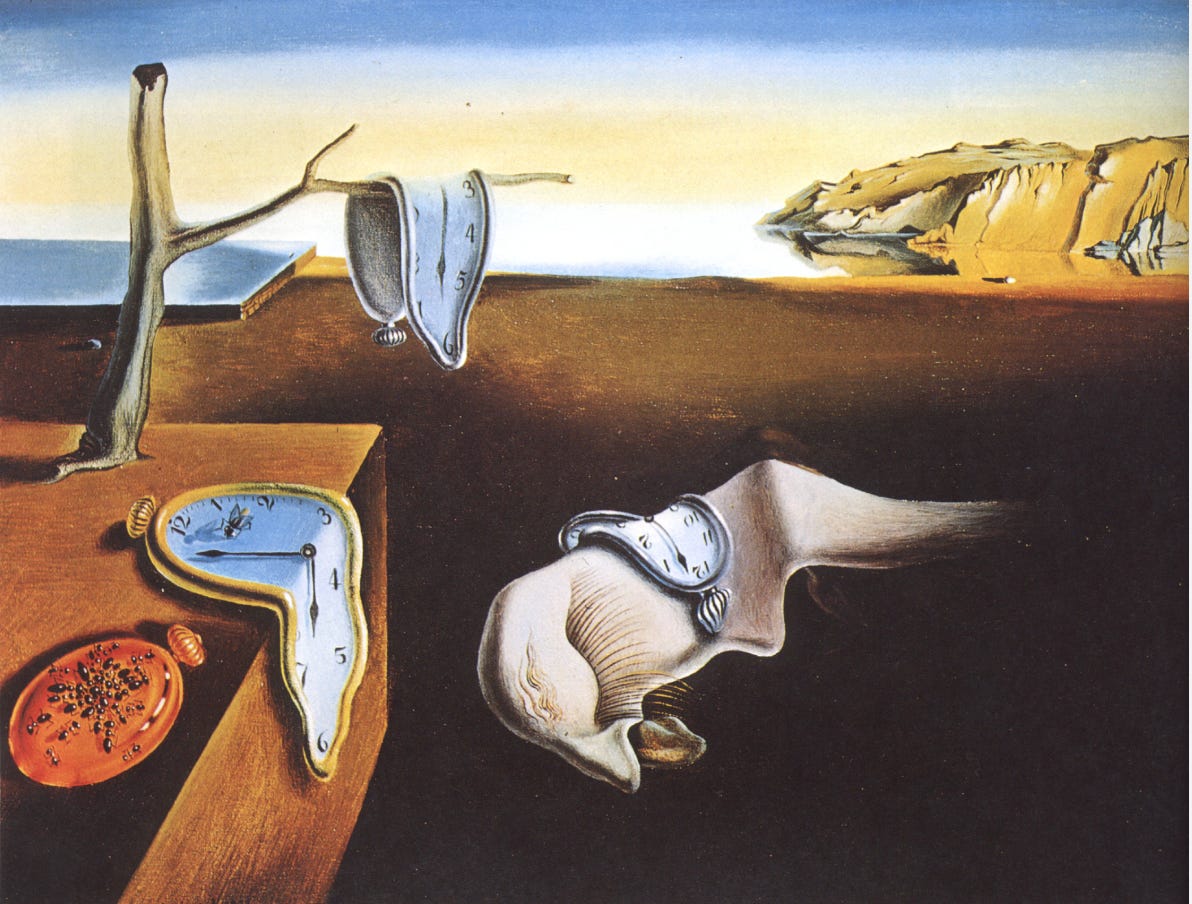
- Salvador Dali, The Persistence of Memory
In Michel de Certeau’s 1980 book, “The Practice of Everyday Life,” he likens riding in a train car to “incarceration.” The traveller is “pigeonholed, numbered and regulated in the grid of the railway car,” and yet it is here where “rest and dreams reign supreme.” He continues, writing, “There is nothing to do, one is in the state of reason. Everything is in its place. […] The train generalizes Dürer’s Melancholia, a speculative experience of the world: being outside of these things that stay there, detached and absolute.” This apartness he feels from the world whizzing by his window becomes a “beautiful abstraction,” an “incarceration-vacation” that creates the space for lazy thoughtfulness and dreams, for “atopical liturgies, […] parentheses of prayers to no one,” where the “Traveller/Dreamer” can observe and witness her fellow man. Now, more than 45 years later, the train is an excuse to play games, scroll social media, and listen to music or podcasts, encased in further layers isolation and detachment.
This is not to say that all “content” is a waste of one’s time. But it is to invite consideration that the flood of that self-same “content” is part of the larger issue of time’s acceleration, and our inability to slow ourselves down.
Our phones on the tiny table
like decks of cards
are silenced, but they light, they shake.
We know that they’re thinking.
Billions of years
none of the cosmic issues have been settled.
Water’s still seeking its own level,
the planet needs a few more eons
to figure out what it all comes down to.
On the smaller scale, it’s hesitantly spring,
and the server says No problem, back in a few.
Where we want to be is exactly
where we are,
but there’s no way to get there
from here.
-James Richardson, Meeting Again After Decades
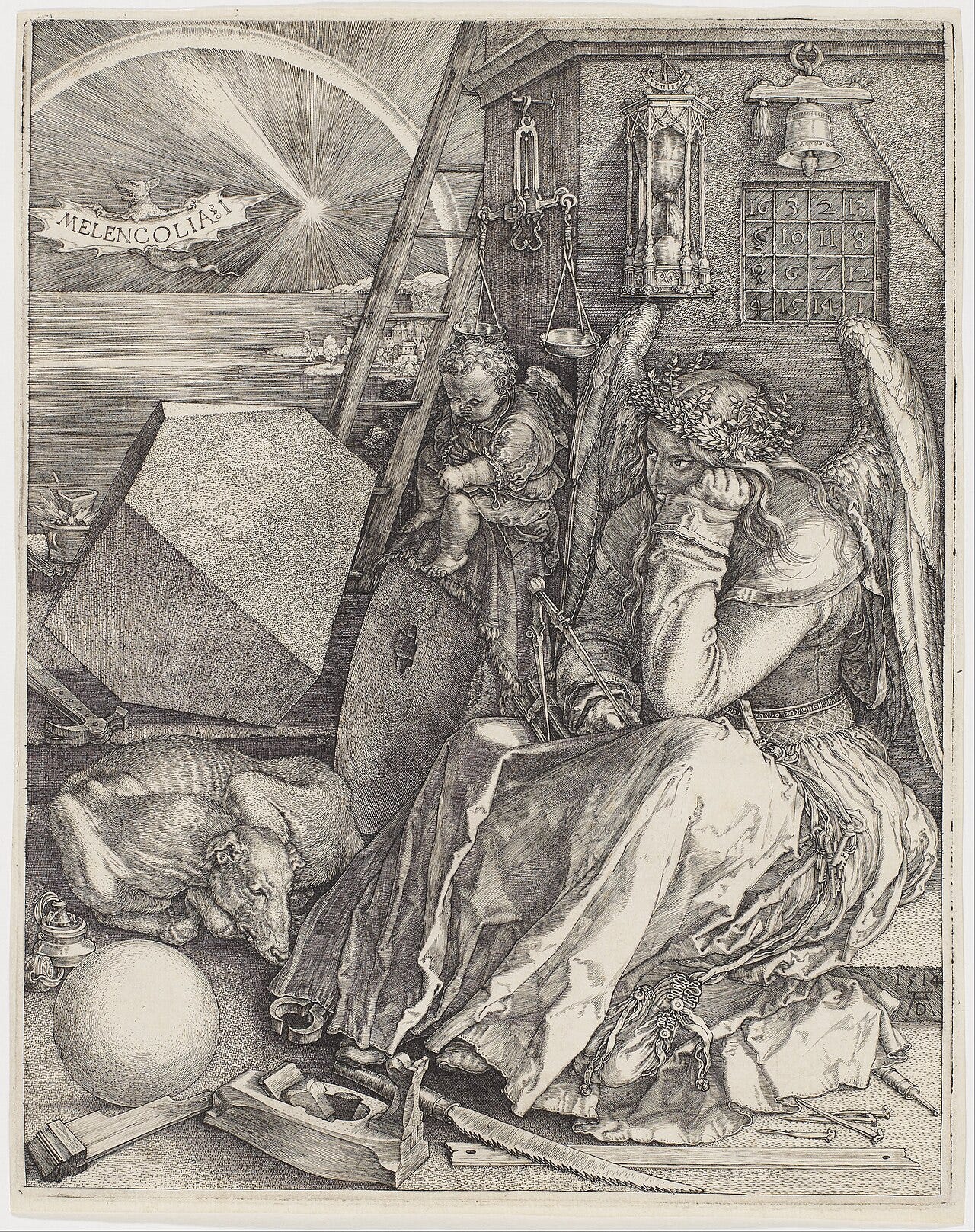
-Albrecht Dürer, Melencolia I
Joshua Rothman, staff-writer at the New Yorker, wrote a piece entitled, “After the Algorithm,” that sums it up fairly well: “A couple of decades into the smartphone era, life’s rhythms and the algorithm’s have merged. We listen to podcasts while getting dressed and watch Netflix before bed. In between, there’s Bluesky on the bus, Spotify at the gym, Instagram at lunch, Youtube before dinner, X for toothbrushing, Pinterest for the insomniac hours.”
Rothman continues, writing that, “Algorithms are [...] essentially, mathematical procedures for solving problems. We use them to coordinate physical things (like elevators) and bureaucratic things (like medical residencies). Did it make sense to treat unclaimed time as a problem? We’ve solved it algorithmically, and now have none.”
It’s an interesting question–”did it make sense to treat unclaimed time as a problem?” For the Achiever with an active life, it is. Time spent not achieving, is time wasted. And as our time-based observances have decreased, our unclaimed time has risen, and yet we do not fill this “spare time” with contemplation, often opting instead for some brand of consumption. “A feeling of overstimulation is one consequence of algorithmic life,” writes Rothman, “Another is a certain jumbledness in our ideas.” We’d argue, too, that yet another is the acceleration of time’s passage.
Han believes that dyschronicity makes us “radically transient.” Just imagine Certaeau’s dream/traveller for a moment, riding the train, only now dissociated inside a phone. Where even is she? Lost in some multi-dimensional liminality. Han goes on to argue that this phenomenon of speeding time causes us to “age without becoming old,” to gain the years but not the wisdom. And what’s left after the complete atomization of time? Our lone egos seeking the fluid goal of “achievement.” This is what Han calls “Poverty of World,” in which there are no others involved in our lives because we are too caught up in our own pursuit of success and self-realization. Jungians, among many other psychotherapists, understand human relationships as foundational in defining one’s identity—we learn ourselves through our interplay with others. But in our ego-focused achievement-quest, we are reduced to a “tiny body that is kept healthy at all costs,” because it is our only means of production.
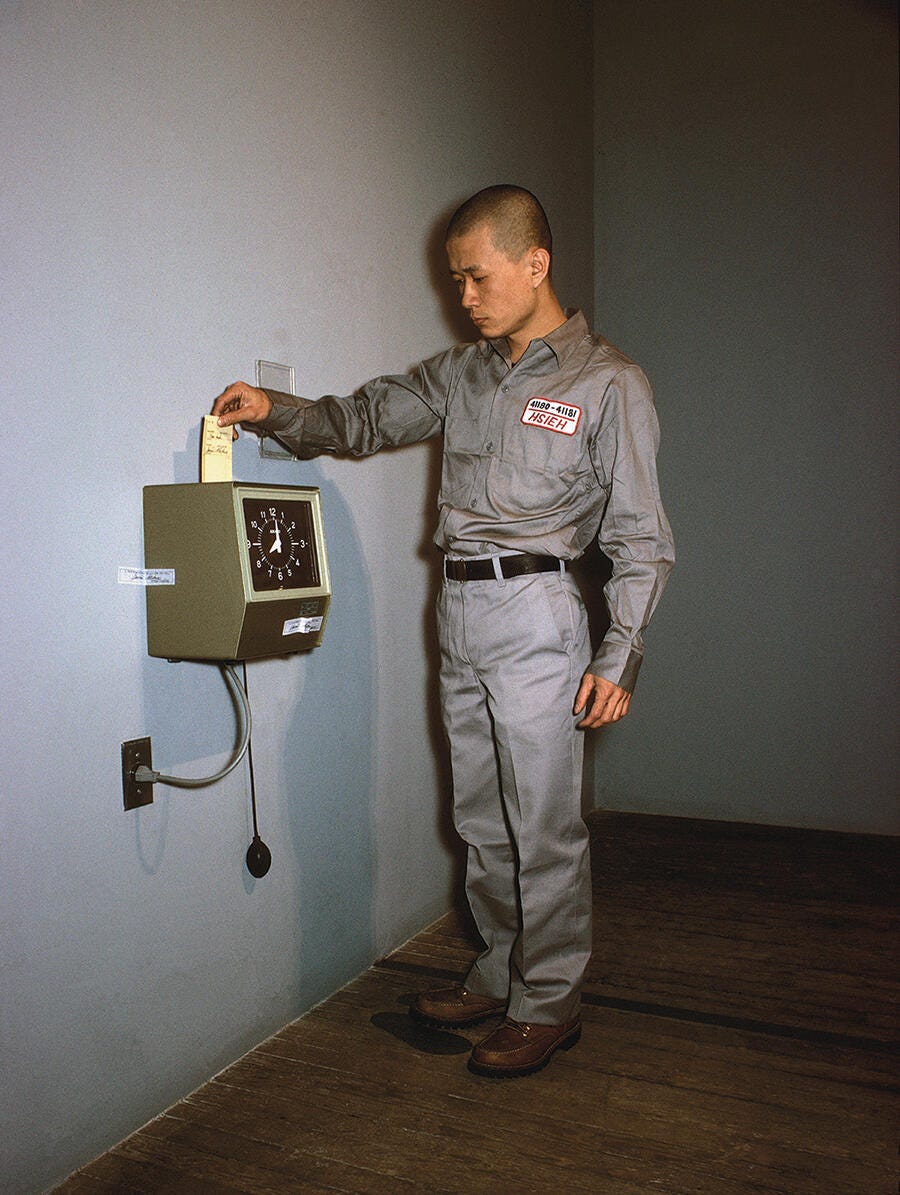
- Tehchin Hsieh, One Year Performance (Time Clock Piece), 1980–1981
It’s the loss of cultural heritage, traditions and ritual that has let time run off like a speeding train. Han argues that “life is no longer embedded in any ordering structures,” and without ordering structure, time becomes directionless, and uncontrolled. This helps illustrate the modern feeling of constantly rushing, struggling to catch up, and living at the ends of our noses. Some may think themselves “time-blind,” uniquely unable to keep track of time, but they may also just be experiencing what we all are: a lack of order.
Rituals–be they spiritual or of the daily variety–can create structure within time, like touchstones across a river that allow us to keep track of ourselves while crossing. There are daily touchstones like feeding the animals, reading, journaling, finishing the crossword, or prayer. But there are also seasonal observations like national or cultural holidays, annual celebrations or events, birthdays, phases of the sun and moon. Each of these points is fixed in time and provides a reminder of where we are in the river, so to speak. The more of these touchstones we have, the more manageable time becomes. Through the practice of keeping time via ritual or observance, patterns will arise, conscious and not, that allow life to become more predictive and reliable, bringing faith and ease where once there was faceless anxiety.
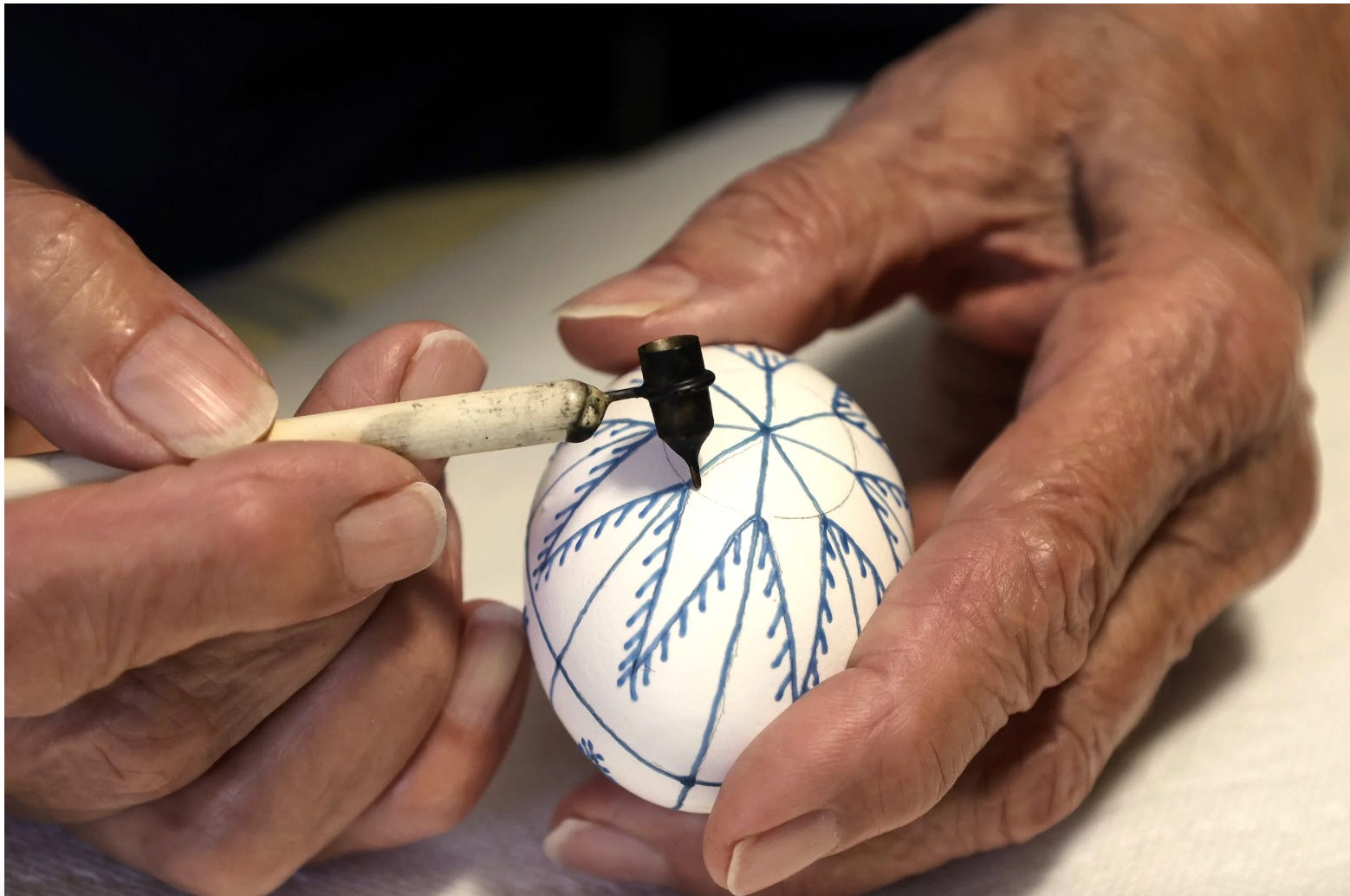
- Pysanky, a Ukranian egg painting ritual
As a matter of fact, we stand today on one such touchstone–the Spring Equinox, celebrated around the world with various customs and traditions. The Spring Equinox is the threshold into a new season, a time of expansion and growth after a long, dormant period of gestation. Many northern European communities once engaged (and some still do) in the Marzanna Parade, in which Winter is made an effigy of straw, dressed in white and paraded through towns and villages to then be burned and tossed in a river or lake as a welcome to Spring and ensure a good harvest. The painting of eggs for Easter came through the Celtic tradition of Ostara, celebrated over the Equinoctial transit, in which the fertility of the wild hare was symbolically bound to seasonal rebirth, represented by the egg. These festivals rooted their communities firmly in time and therefore created relationships to the annual period and made patterns of its temporal surroundings.
Similarly, transhumance, or the seasonal nomadic movement of livestock, is another common marker of time. And, as it happens, this spring Kathryn will be co-hosting a retreat in Morvern Scotland where the group will undergo such a passage, stewarding horses and cattle to their spring pasture. Throughout the full day’s journey pace and time will be a constant and unconscious conversation between the stewards and the animals, as the group will navigate terrain and time together. The entire retreat plans to be a lovely meditation on slowing down and finding the deeper rhythms of life lost in the buzz of the attention economy.
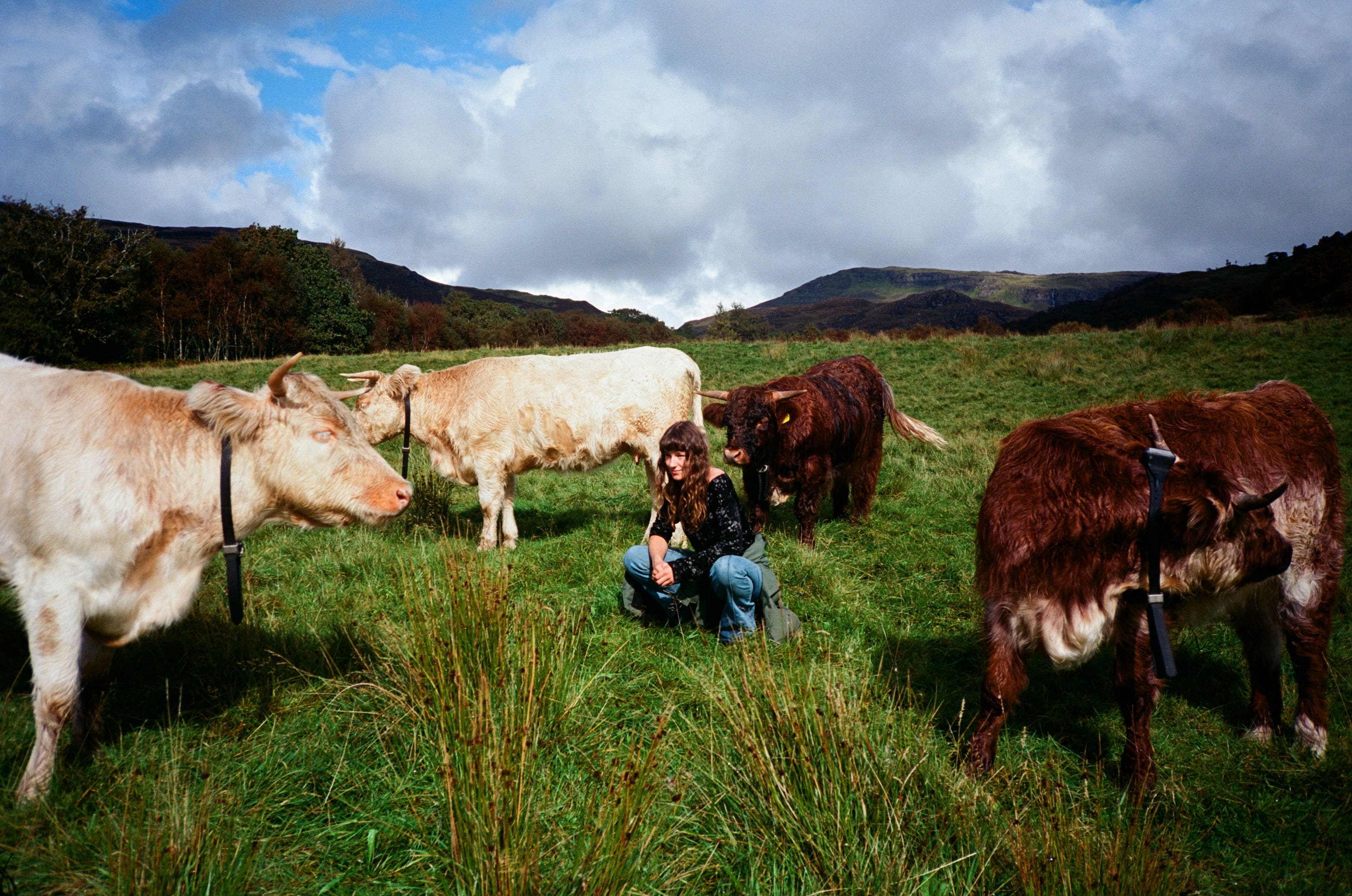
- Lizzie with the herd in Morvern
I’m herdsman of a flock.
The sheep are my thoughts
And my thoughts are all sensations.
I think with my eyes and my ears
And my hands and feet
And nostrils and mouth.
To think a flower is to see and smell it.
To eat a fruit is to sense its savor.
And that is why, when I feel sad,
In a day of heat, because of so much joy
And lay me down in the grass to rest
And close my sun-warmed eyes,
I feel my whole body relaxed in reality
And know the whole truth and am happy.
-Fernando Pessoa, The Herdsman
Without heritage, tradition or ritual to mark its passing, we become self-focused and lost in the dizzying rush of time. In this state we become overworked, overtired and overwhelmed. We develop addictions to work or perfection, the internet and pornography, or any other numbing strategy that allows us the illusion of control and avoid less favorable feelings. And suffering this way long enough, we can experience burnout when the body cannot physically bear it anymore.
Like the Zapatistas say, those revolutionaries of southern Mexico whose radical symbol is the lovely and slow spiral-shelled snail, “Another world is possible.” A life of contemplation that honors time-based observances and rituals is possible. The solution for much of our modern anxiety is to slow down time by marking it with rituals and events that bring your life color, and attending to the feelings that you may rather avoid. By detaching now, not form ourselves, but from the forced upon rhythms of fast-paced life, we can re-acclimate to our own personal pace and sink into the timing of nature. It isn’t easy; the pull will always be present to not get “left behind.” But what new insights or creative spark might we find when we take the clock down from off the wall and build a more personal relationship with each passing moment?
In time,
Inner Vision