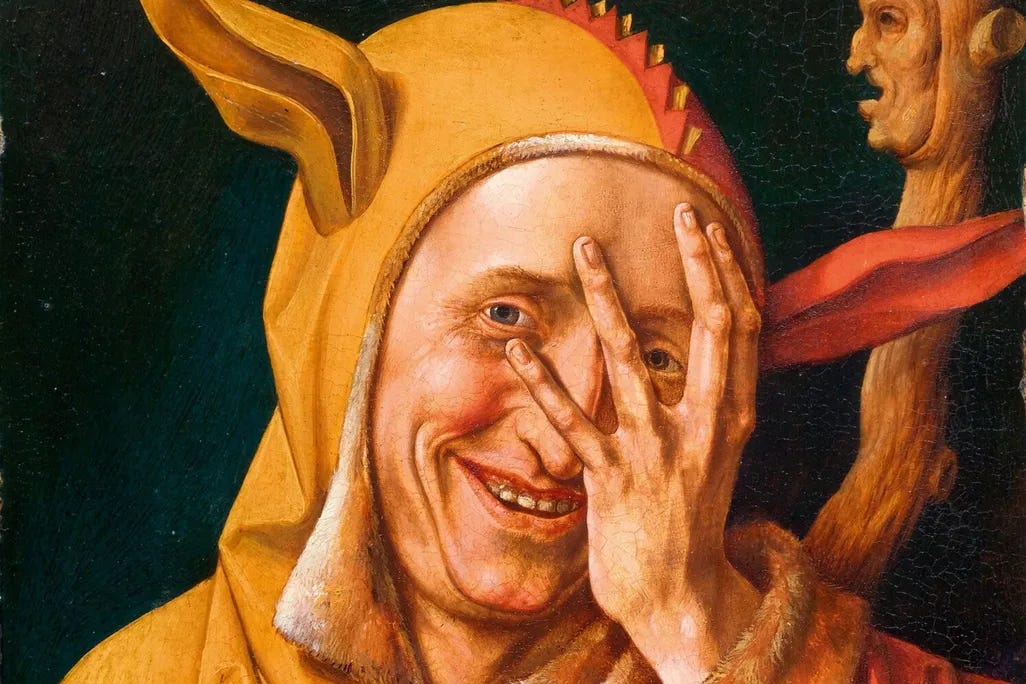
Fools Gold
On Finding Lost Treasure With Our Inferior Function

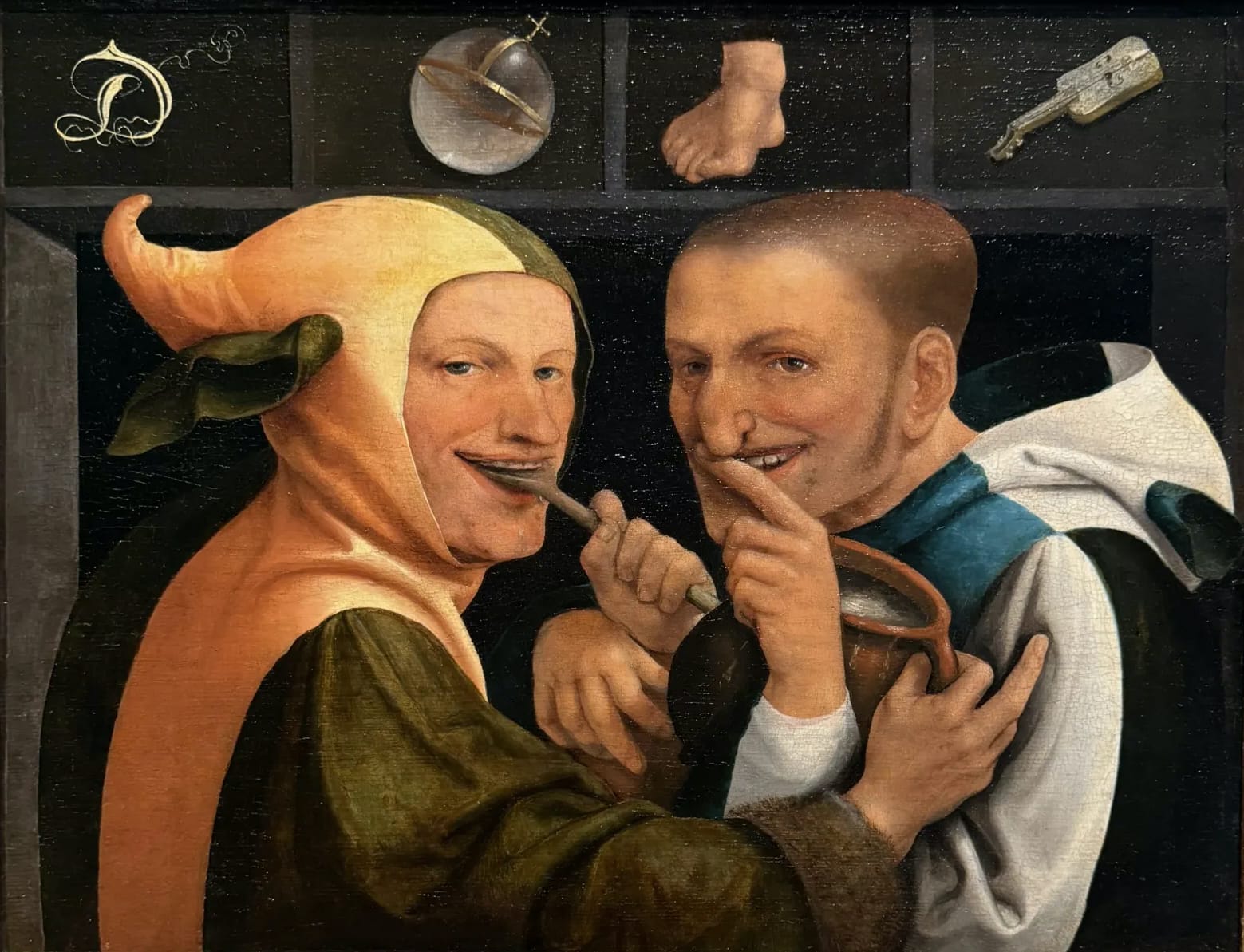
-Jan Massys, "Riddle: The World Feeds Many Fools" (1530)
Listen while you read. Find the “Fools Gold” playlist here.
“The fool doth think he is wise, but the wiseman knows himself to be a fool.” - William Shakespeare
Something stirs at the start of the new year. Maybe it’s the optimist in us, but despite what dread may be prevailing in the world, the start of something new calls dreams and visions to mind for what could be. As is customary, many people set resolutions for the coming year–often hard to keep promises made to oneself that would change one’s life for the better. Hope springs eternal as it seems we always long to progress toward a distant goal where we are a more congruent, whole and un-fragmented version of ourselves that feels more aligned, energized, connected and satisfied.
And maybe it is naive to think this way; foolish to still have hope in a world that feels to be forever darkening. Cynicism seems much more inviting than the hard, uphill work of hope and change. But we would like to argue that foolishness is just what we need in times like these.
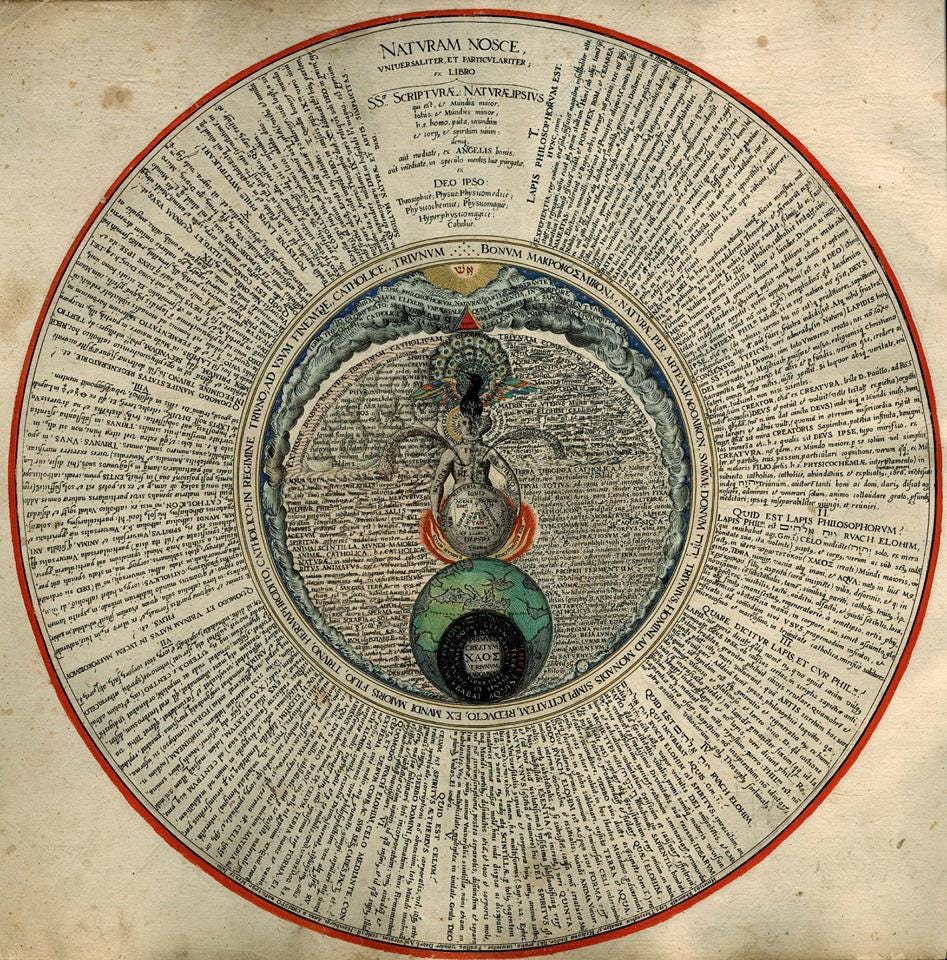
-Paulus van der Doort - The Philosopher’s Stone
The philosopher’s stone is a mythic alchemical substance that is said to hold the power to turn base metals into highly valuable silver or gold. Beyond material wealth, those in possession of the philosopher’s stone are thought to be able to achieve immortality. Some have used the philosopher’s stone to explain the prolonged lives of the biblical patriarchs who are said to have lived for hundreds of years, long before the birth of Christ.
The ancient alchemists taught that the stone, the greatest treasure of all, would never be found where we might expect it—not in some sacred vestibule nor holy site. Rather, they were of the mind that this powerful tool would only ever be found in the places most easily dismissed. Renaissance philosopher, Johanne Fabricius wrote in “Tractatus aureus” that “our most precious stone, cast forth upon the dunghill, being most dear, is made of the vilest of the vile.” Fairytales are filled with these “diamond found in the rough” narratives, from Cinderella to the great many toads and unsavory creatures who await true loves kiss to be turned into royalty. What we want, what we hold in highest regard or value, these stories and philosophers of old tell us, is to be found in the vilest of places: the dung heap.
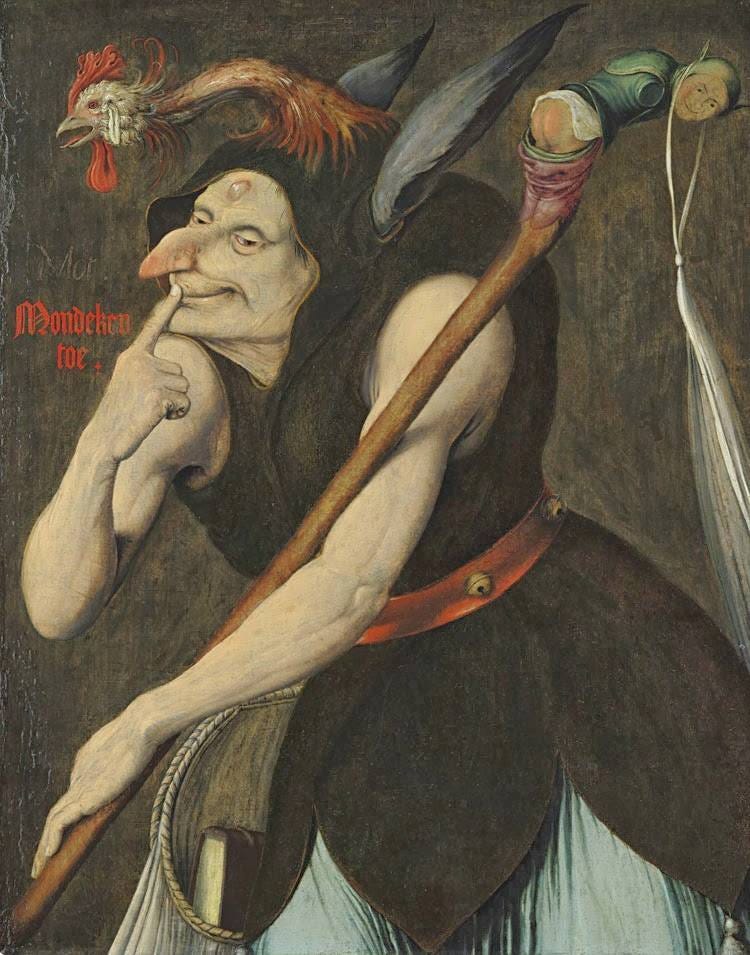
-Quentin Metsys (1466-1530) ~ An Allegory of Folly
The Fool, as an archetype, lives somewhere along a spectrum between the Child and the Trickster. The archetype borrows the simplicity and innocence of the Child and the Trickster’s incredible ability to pierce delusion and hypocrisy with cunning wit. The Fool, in these ways, stumbles honestly into revelation thanks to his clumsy, open-heart.
The Fool tends to represent that which the larger culture or even personal psyche does not value. It seems to be a fact of nature that whatever falls out of consciousness inevitably finds its way bubbling back to the surface, whether through some crack in the wall or plugged up drain. And in this way, the Fool returns, again and again, to challenge our notion of what’s right and respectable. The archetype lives in the collective junkyard of our personal and collective unconscious, where transcendent alchemy waits.
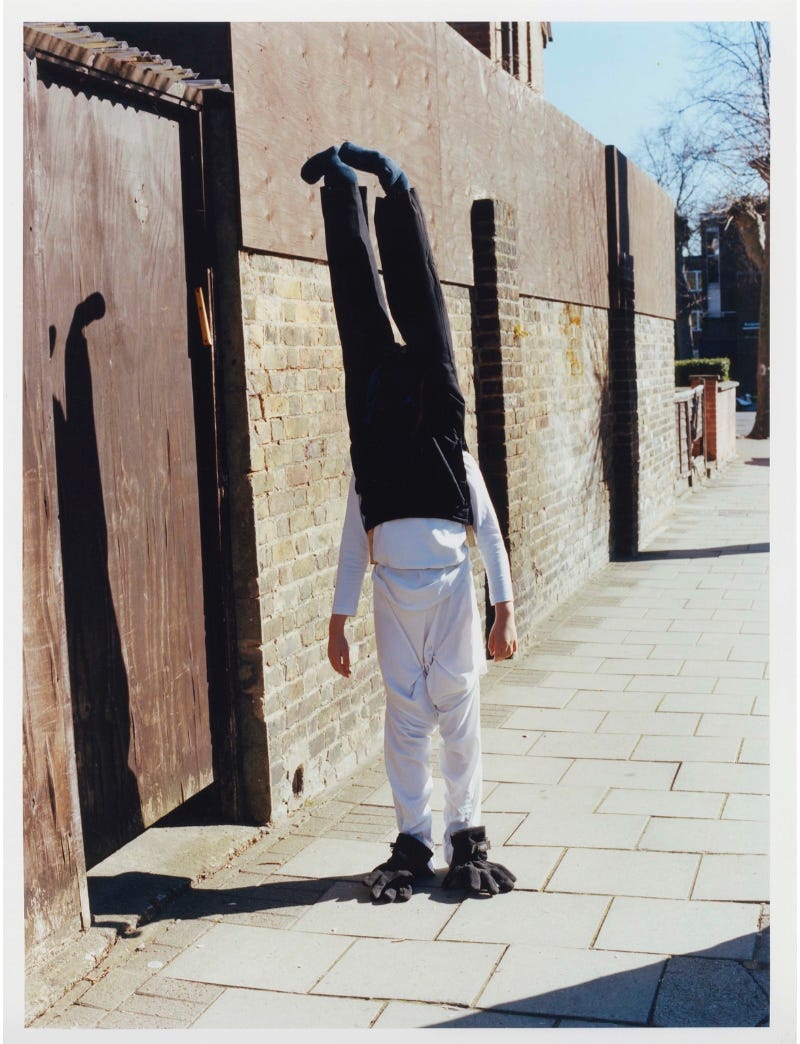
- Estelle Hanania
The Fool, due to their innocence, is unafraid of what we keep in our shadow. “Fools rush in where angels fear to tread,” goes the old saying, and here those angels act a lot like our egos—white-knuckled and terrified of what lies beyond the edge of light where all our unwanted thoughts and behaviors have been stuffed away like skeletons in a closet. Where we might be afraid to travel and even more afraid to interact, the Fool is unconcerned. This archetype is able to approach the molehills we so fear to be mountains and accept our inner monsters for the wounded children they truly are.
One of the main lessons the Fool teaches, and this is often done through humor, is to remind us that we all are capable of tripping on our shoelaces or farting at a funeral. Though the archetype likely couldn’t give word to the sentiment, it remains nonetheless true—“nothing human is alien to me.” Similarly, the Fool is not interested in strategic plans or long-term goals. The Fool lives within the flow of life, free from social constraints and expectations, and able to live as if without a persona–unfiltered, unvarnished, and wholly oneself. The Fool is not unlike the Zen concept of beginner’s mind–open hearted, open-minded, available to discovery and surprise.
“The way that can be told is not the constant way; the name that can be named is not the eternal name.”
-Lao-tzu
Now, this is not an invitation to embody the Fool at all times. We still need plans, ideas, thoughtfulness and consideration. Our invitation to work with the Fool is a part-time job. It is to practice letting go of the outcomes so we can be more present along the way. It is to open our hearts to new possibilities and be willing and able to be moved by wonder and awe. In a very real sense, this is spiritual work.
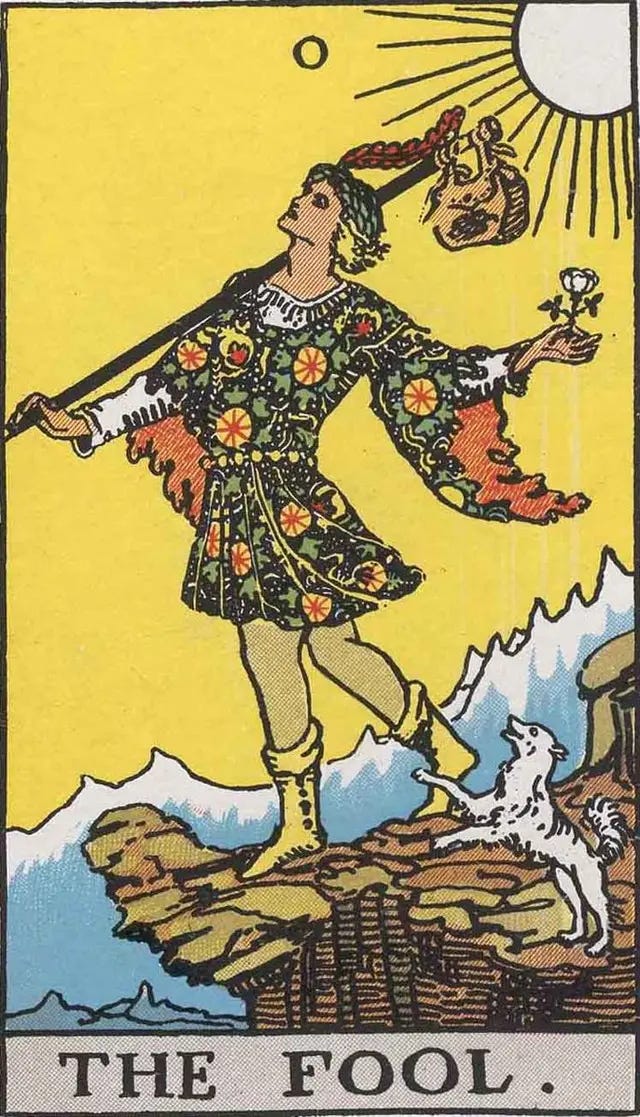
-Thoth Deck from Rider–Waite Tarot deck
In the tradition of the Tarot, the Fool, or zero card, is seen as the spiritual peak. Pictured as a young man at the edge of a cliff, whose next step may take him over the edge and to his death. The sun shines high above him, a dog, perhaps begging him to stop advancing, at his feet, the card symbolizes both the cheer and optimism of youth, the spiritual ascent typical of a high mountain peak, as well as the thin line between the bliss and destruction of being foolish.
Additionally, there are fiery flourishes to his clothes, likely a reference to the etymology of the word Fool, which comes from the latin “follis,” meaning bellows or windbag. A bellows is a type of windbag used by blacksmiths to pump air in their forges and further stoke the fierce fires needed to bend metals. Needless to say, Fools are mighty capable of being windbags in the derogatory sense, as well as stoking the internal fires–that is, rage–of those at the other end of their foolishness. Whether unintentionally challenging the status quo, or making one’s hypocrisy felt deeply, the Fool has a tendency to complicate people’s simple worldview and upset the false balance they presume to have achieved. And what’s worse, this is done not through clever scheming but via simple, innocent mistakes and pratfalls that remind us of our fundamentally fallible humanity.
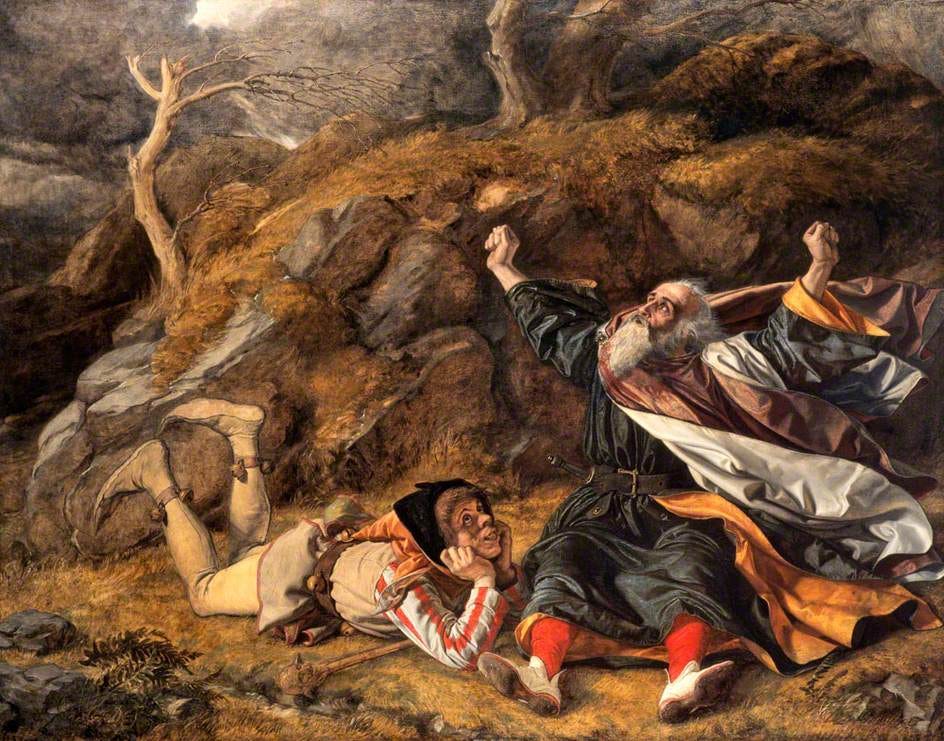
-William Dyce, King Lear and the Fool in the Storm
Author and lecturer Stephan A. Hoeller wrote in his book, “The Fool’s Pilgrimage,” that “the Fool or zero card is in many ways the most significant and most powerful of the cards of the Major Arcana, because it symbolizes the pristine spiritual source and ultimate destiny of all manifest powers and beings. It stands for the Alpha and Omega of manifestation, the No-Thing out of which all things proceed and into which they resolve at the end of the aeons. Being the symbol of this primal causeless cause, and thus utterly abstract and unsubstantial in nature, this card would spell foolishness to the worldly. From the vantage point of the spirit, all earthly gain is of no account; the road to earthly attainment leads nowhere, means nothing, and ends in nothing. The wisdom of the world is foolishness in the sight of the gods, and, conversely, the Divine Wisdom appears as foolishness in the sight of men.”
Howler goes on to write that, “All appearance is deception, and only at the center of the great circular dance of creation, where the Fool stands in still, motionless serenity, do we find that which no longer deceives by appearances, because it no longer appears, but is.” This notion that the Fool represents what lies beyond the mask, under all the diligent work of the persona, speaks to a serene core in all of us that is only reached through a beginner’s mind. It speaks to a universal quality hidden under all the many layers of the human psyche. A space we can only hope to tap into for brief periods before returning to the palimpsest of consciousness.
If when my wife is sleeping
and the baby and Kathleen
are sleeping
and the sun is a flame-white disc
in silken mists
above shining trees,—
if I in my north room
dance naked, grotesquely
before my mirror
waving my shirt round my head
and singing softly to myself:
“I am lonely, lonely.
I was born to be lonely,
I am best so!”
If I admire my arms, my face,
my shoulders, flanks, buttocks
against the yellow drawn shades,—
Who shall say I am not
the happy genius of my household?
-William Carlos Williams, Danse Russe
According to Carl Jung and his many disciples, human beings utilize four major psychological functions that help us to live our lives. These are: thinking, feeling, sensing, and intuition. Of these four functions, Jungians teach, there is one with which we are strongest, most experienced and adept. This stands to reason that there would also be one which is weakest and least used. Jungians refer to this as the “inferior function.” Perhaps we aren’t very attuned with our emotions, or because of our intellect we don’t pick up on the bodily signals that, for example, remind us to eat food or drink water. Or maybe we feel inadequate as a problem-solver, or too impatient to think things through clearly; or, perhaps we lack the ability to feel into the right decision or anticipate the right timing or flow of life. One of these four functions must fall short of the others. So, to draw a natural conclusion: in one of these aspects, you, my friend, are a fool.